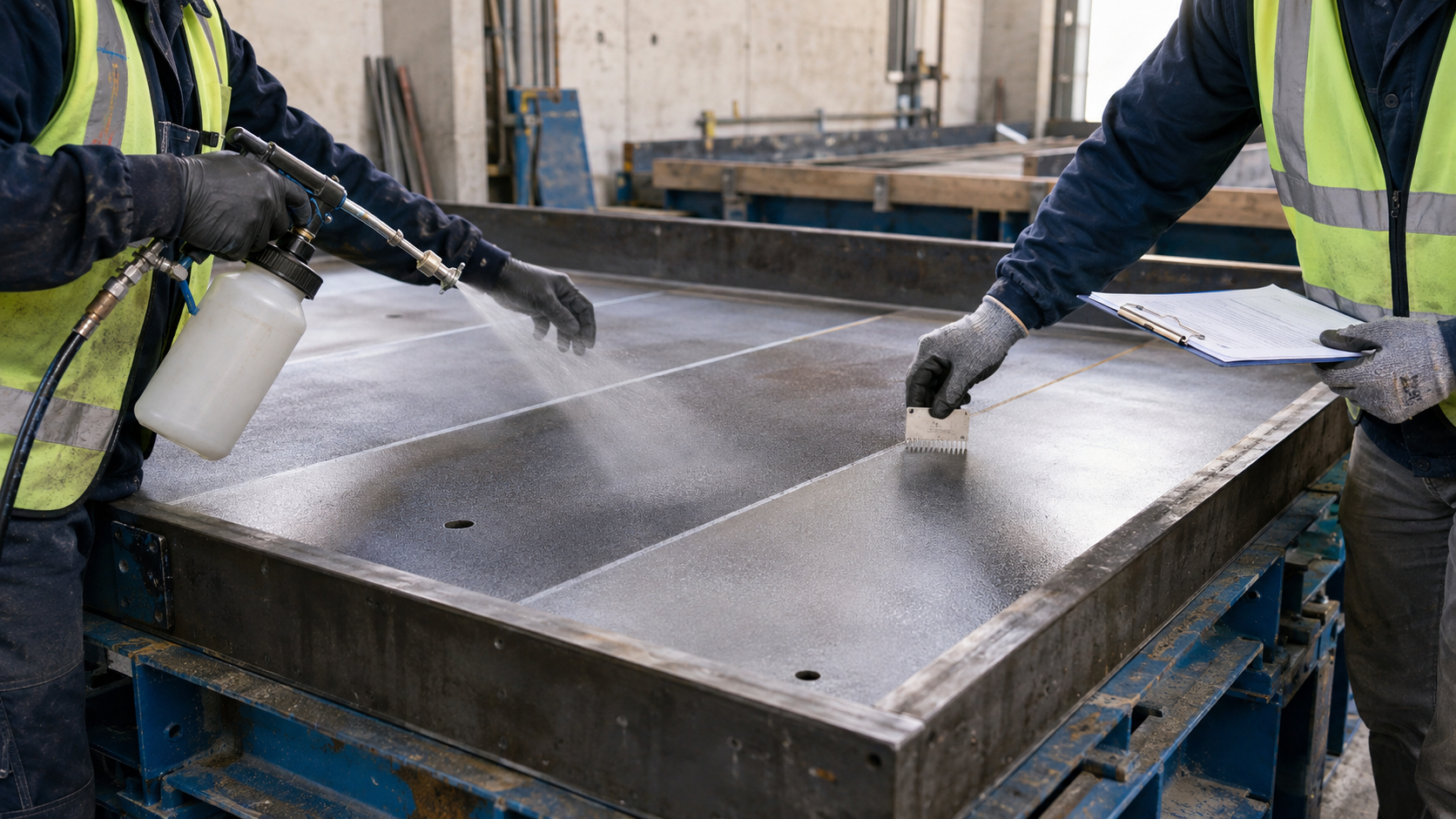
Precast and cast-in-place concrete can use similar release-agent chemistry, but they do not create the same working conditions. A precast plant may repeat the same formwork cycle many times under a controlled routine. A cast-in-place project may use larger panels in changing weather, with different crews, waiting periods, and formwork conditions from one pour to the next.
That difference changes how the release-agent system should be selected, applied, checked, and accepted. The correct question is not simply which product releases concrete. It is whether the product and application method can create a stable, clean interface throughout the actual project cycle.
For the material-specific part of the decision, see How to Choose a Release Agent by Formwork Material. For the measurement and acceptance process, see How to Set a Concrete Release Agent Spray Standard.
The Main Difference Is the Working Cycle
| Factor | Precast concrete | Cast-in-place concrete |
|---|---|---|
| Formwork cycle | Repeated and scheduled | Changes with the pour sequence and site program |
| Main control goal | Repeatable release and low residue over many cycles | Consistent release across changing panels and conditions |
| Typical risk | Film buildup, cycle-to-cycle drift, or contamination | Weather, waiting time, missed coverage, or local panel differences |
| Application routine | Calibrated equipment and repeatable operator steps | Zone control, site coordination, and visual checks before casting |
| Acceptance focus | Surface consistency, production rhythm, and form reuse | Surface quality, local defects, and readiness for the next pour |
Neither process is automatically easier. Precast offers more opportunity to standardize, but small errors can repeat across many units. Cast-in-place work has more variable conditions, so the team needs stronger checks when the panel, weather, or schedule changes.
What Precast Projects Need from a Release-Agent System
1. Stable performance across repeated cycles
In a precast plant, the same form may be cleaned, sprayed, filled, stripped, and returned to service many times. A film that looks acceptable on the first cycle can become a problem later if residue accumulates or the application volume gradually increases.
The plant should track more than whether the concrete released. Record the form condition, product batch, dilution basis, application method, visible film condition, stripping result, residue, and cleaning effort. Trends are often more useful than a single good-looking unit.
2. Low residue and a controlled cleaning routine
Residual film, cement paste, and dust can change the next cycle. If the cleaning team uses a different method every time, the form face can slowly become less uniform even when the product remains the same.
The release-agent choice should therefore fit the approved cleaning method and the form coating. Do not select a product only because the first release looks easy. Check whether the form can be prepared consistently for the next cycle without damaging the surface.
3. Equipment repeatability
Precast operations benefit from fixed sprayer settings, a known nozzle condition, and a repeatable pass pattern. The operator should be able to identify missed zones, heavy overlap, and pooling before concrete is placed.
Coverage should be checked by form type and not only by total material consumption. A single plant may use different panels for columns, beams, architectural faces, or small inserts. Each form system can need its own working range.
What Cast-in-Place Projects Need from a Release-Agent System
1. Tolerance for site variation
Cast-in-place formwork can be exposed to sun, rain, dust, wind, temperature changes, and long waiting periods. The release film may be applied in one shift and used in another. A practical standard should define what happens when the surface is rained on, contaminated, or left waiting longer than planned.
Do not treat the same coverage observation as valid after the form condition has changed. Recheck the surface before casting and record whether the film remains continuous and clean.
2. Clear control at difficult zones
Large vertical panels, corners, joints, embeds, tie locations, repaired areas, and the lower parts of forms are common high-risk zones. The spray standard should give the crew a simple inspection sequence for these areas instead of relying on an overall impression of the panel.
If the project uses new and reused panels together, mark them separately in the record. A single average coverage value can hide the local condition that causes sticking or staining.
3. Coordination with the pour and stripping plan
The application window must match the actual site program. If the team sprays too early, dust and weather can affect the film. If it sprays too late, the crew may rush corners or begin casting before the film is ready.
The release-agent record should be connected to the pour location, concrete delivery time, placement method, and planned stripping condition. This makes it possible to investigate a defect without guessing which panel or waiting period was involved.
How Selection Changes by Formwork Type
| Formwork condition | Precast priority | Cast-in-place priority |
|---|---|---|
| Steel forms | Repeatable thin film and low buildup | Clean joints, welds, edges, and weather-exposed areas |
| Film-faced plywood | Consistent coverage over repeated cycles | Dry spots, damaged faces, and changes between panels |
| Plastic or liner systems | Avoid pooling and residue during fast turnover | Check shine, corners, dust, and long waiting periods |
| Repaired or mixed panels | Separate high-risk forms from normal production | Inspect each repaired zone before the pour |
| Architectural finish | Stable color and low surface residue | Consistent appearance across pours and changing conditions |
The formwork material is still the starting point. The project type changes how often the surface is reused and how much variation the process must absorb. Read Concrete Release Agent Compatibility Test: A Practical Mock-Up Protocol before applying one standard to a new form system.
A Practical Test Plan for Either Process
Step 1: Define the actual production condition
Record the form material, surface age, coating or repair status, concrete finish target, product, dilution basis, sprayer, and stripping plan. For precast, include the intended cycle frequency. For cast-in-place, include the expected waiting period and weather exposure.
Step 2: Use representative formwork
Do not test only on a clean, new panel if production will use reused, repaired, or mixed panels. Include joints, corners, inserts, and the surface condition most likely to create trouble.
Step 3: Apply with the planned equipment
Use the actual nozzle, pressure, spray distance, pass speed, and operator routine. Record the amount of mixed material used on the known form area, but do not treat consumption alone as proof of correct coverage.
Step 4: Inspect before concrete placement
Look for missed areas, puddles, heavy overlaps, unusual shine, dust, water, and contamination. If the surface is no longer representative of the test condition, record the change and decide whether the panel should be retested.
Step 5: Inspect after stripping and cleaning
Check the concrete surface and the form face. Record release force or difficulty, staining, color variation, bugholes or drag marks, cement residue, cleaning effort, and whether the form is ready for the next cycle.
Step 6: Set separate acceptance notes where needed
The same product can be accepted for one form system and rejected for another. Keep the acceptance record tied to the process, formwork, finish target, and application method instead of treating the product name as the entire specification.
Acceptance Checklist
| Check | Precast question | Cast-in-place question |
|---|---|---|
| Form preparation | Can the same cleaning result be repeated each cycle? | Is the panel clean after site exposure and waiting? |
| Film coverage | Is the spray pattern stable across the production form? | Are corners, joints, repairs, and lower zones covered? |
| Timing | Does the film fit the planned cycle? | Was the time from spraying to casting recorded? |
| Surface result | Is color and texture consistent across units? | Is the finish consistent across the pour and adjacent panels? |
| Form result | Is residue low enough for the next cycle? | Can the panel be cleaned and reused as planned? |
| Decision | Continue, adjust, or run a new cycle test | Accept, repair, or retest the affected area |
Common Mistakes to Avoid
Using one coverage number for every process
Coverage is a useful control value, but it is not a universal product property. It changes with formwork, dilution, equipment, operator, weather, and film target. Keep the number tied to the tested system.
Increasing the spray volume after every defect
Sticking may come from missed coverage, but it may also come from old residue, early stripping, low concrete strength, or a damaged form. Increasing the film without checking the cause can replace sticking with stains and residue.
Treating a successful precast cycle as proof for cast-in-place work
A controlled plant cycle does not reproduce rain, dust, long waiting periods, or changing panels on a construction site. Use a site-representative test before transferring the process.
Ignoring the next cycle
A release agent should be judged by release, appearance, residue, and the condition of the form after cleaning. A first pour that looks good but creates difficult buildup may not be a successful process.
Conclusion
Precast and cast-in-place concrete need the same basic objective: a thin, continuous, compatible release film that supports clean stripping and an acceptable surface. The difference is how the process must control repetition and variation.
For precast, focus on cycle-to-cycle repeatability, residue, equipment calibration, and form reuse. For cast-in-place, focus on changing weather, waiting time, difficult zones, panel differences, and coordination with the pour. Test the real system, record the variables, and keep the acceptance decision tied to the actual formwork and process.
For product and formwork matching, continue with the concrete release-agent solution on the main site.