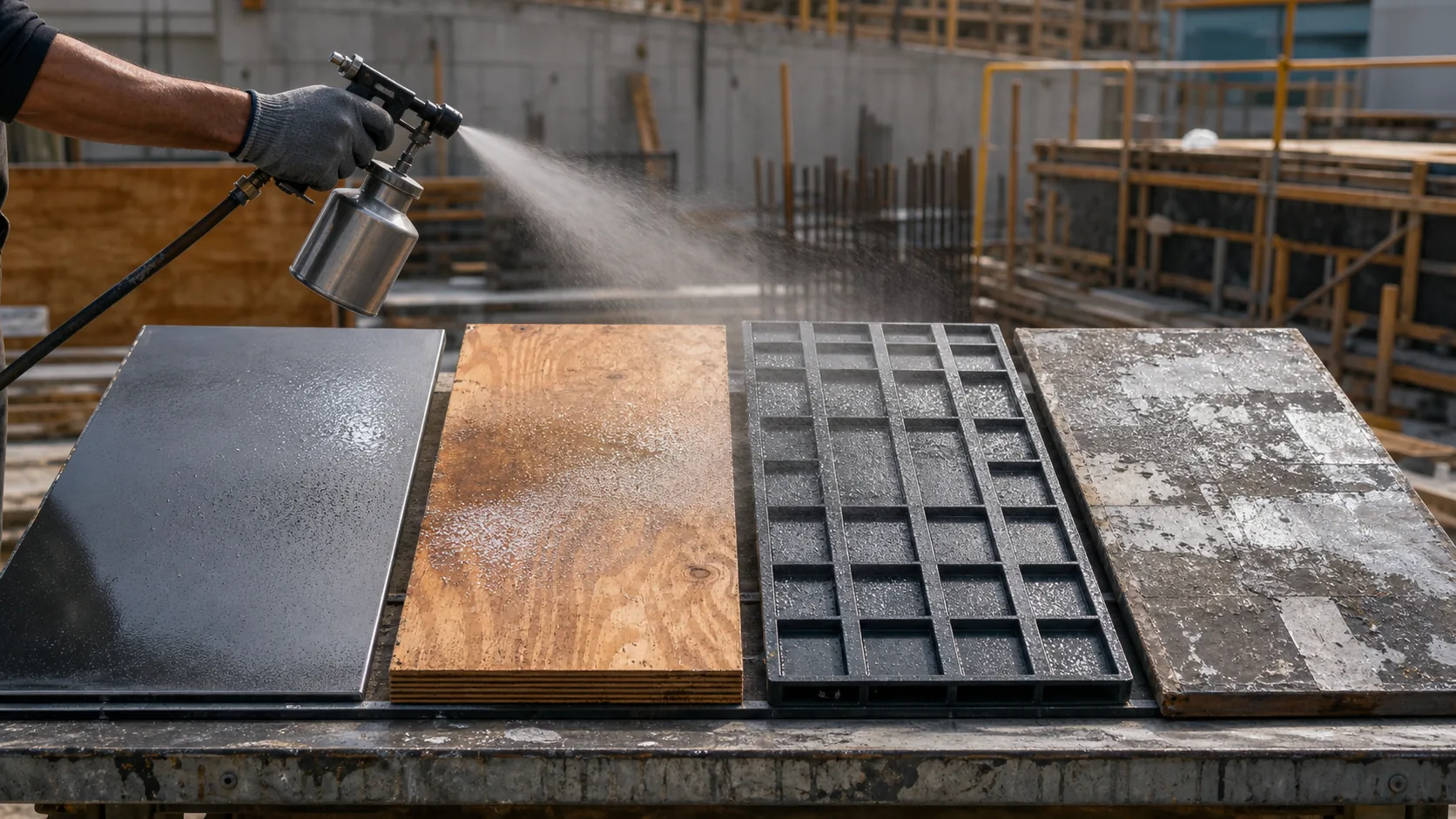

Choosing by brand alone leaves out an important part of the decision: the formwork surface. Material, coating, age, repairs, moisture, and cleanliness can affect how a product applies and releases. A result on one form face may not transfer to another, so check the product data and validate the setup on the panels used for the project.
That is why the first question on site should not be “Which product do we have?” It should be “What is the formwork made of, and what kind of finish does it need to produce?”
For the broader application context, read Release Agent Application: Spraying, Coverage, and Quality Control, Concrete Release Agent Coverage Rate, and Can Too Much Release Agent Cause Staining on Concrete?.
Why Formwork Material Matters
The form face influences how a release product applies and performs. Some surfaces absorb more than others, while coatings, joints, welds, and repairs can create local differences. Use the product’s compatibility information and assess the actual panel condition.
Product chemistry and the form surface both matter. If you ignore the material and condition of the form, the selection decision is incomplete.
Steel Formwork
Steel panels are often less absorbent than wood-based forms, but coatings, surface wear, temperature, rust, and residue still matter. Confirm that the product is suitable for the steel surface and follow its coverage instructions.
Inspect joints, welds, edges, coating condition, rust, and old cement paste. Validate the application on a representative panel rather than assuming that all steel forms need the same spray setting.
Wood Formwork
Wood-based panels can differ in porosity and surface condition. Species, coatings or sealers, moisture, repairs, and reuse can all change how the release product applies. Inspect the actual panels and use a representative trial to set the method; do not assume that every wood form needs more product.
For exposed finishes, record panel condition and compare the application and stripping result across representative areas. Increasing the amount without a controlled check can create pooling or residue.
Plastic Formwork
Some plastic liners have low-absorption faces, but plastic types, surface treatments, and product compatibility vary. Check the product data and trial the actual liner. Watch for pooling or residue, but do not use gloss alone to estimate coverage.
Repaired or Worn Formwork
Repaired panels are a category of their own. Sanded patches, fillers, old residue, dents, and worn edges all change how the release film behaves.
Treat repaired and worn areas as a separate formwork condition. Record the repair material, coating, surface preparation, and residue. Follow the product’s preparation requirements and validate the application on those areas; do not assume they must be dry unless the product instructions say so.
Quick Decision Guide
| Formwork type | Main risk | What to check first | Best spray habit |
|---|---|---|---|
| Steel | Local residue or pooling | Joints, welds, coating, and edges | Follow product-specific coverage |
| Wood | Variable absorption | Panel condition, coating, and moisture | Validate on representative panels |
| Plastic | Compatibility or pooling | Liner type, finish, and corners | Follow product-specific method |
| Repaired panels | Local surface differences | Patch material, coating, and residue | Inspect and validate separately |
How to Check the Film Before Casting
Before the pour, inspect for missed areas, pooling, runs, and uneven application. Products differ in appearance, so do not use wetness, dryness, or gloss as the sole pass/fail test. Compare the application with the product instructions and the representative trial.
Common Mistakes
The most common mistake is using the same spray volume on every formwork material. Another is assuming that a smooth-looking panel will always behave the same way as a porous one.
People also forget to treat repairs as separate risk zones. That is often where the worst stains or sticking show up first.
Conclusion
Material first, product second. Steel, wood, plastic, and repaired panels all need slightly different release-agent behavior, even when the same chemistry is used.
If the project needs a clean exposed finish, choose the product after you understand the form face, not before. That small change in sequence usually saves a lot of trouble later.
For the broader surface-quality workflow, continue with Fair-Faced Concrete Finish: 3 Factors for Better Quality.