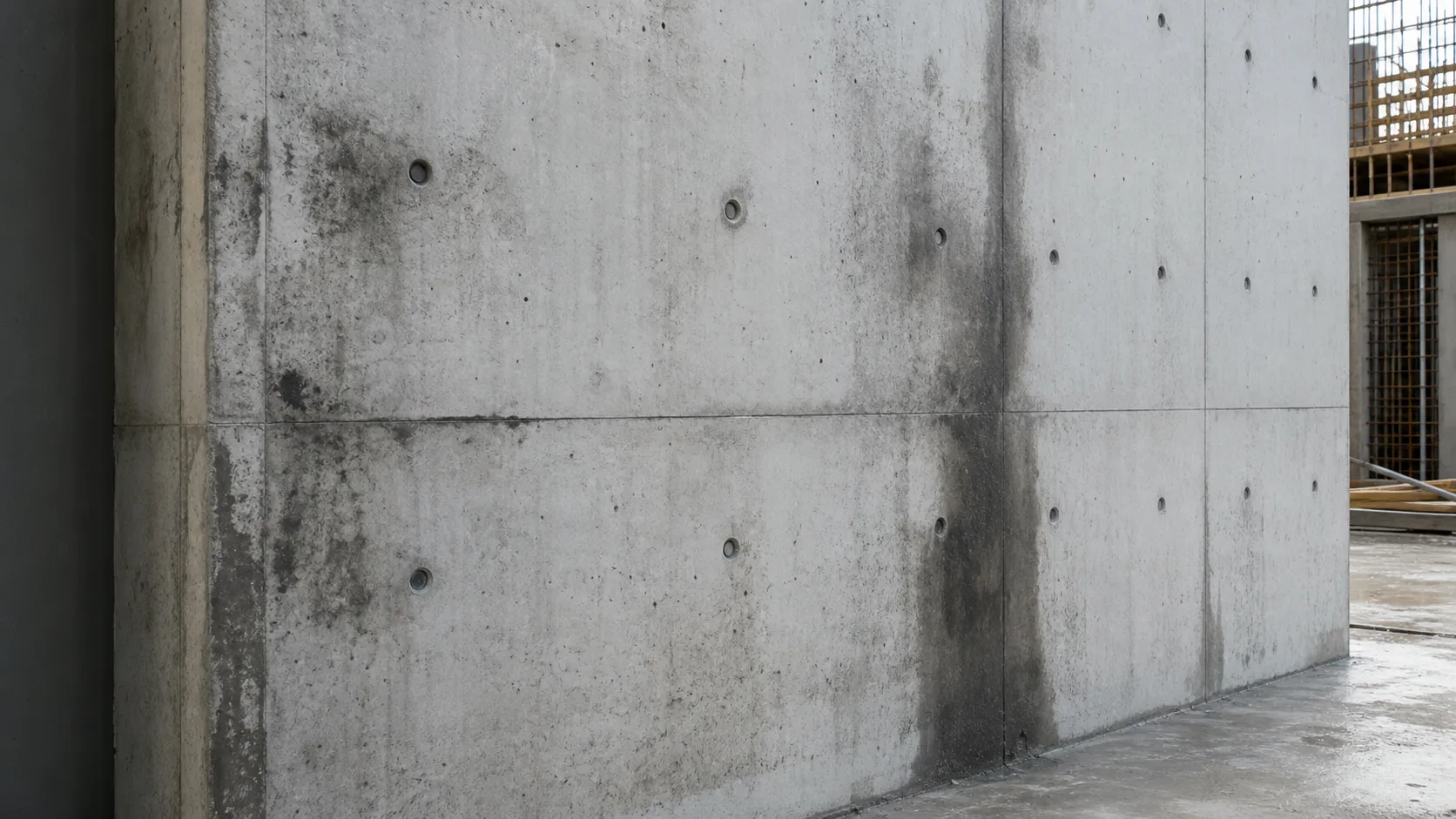
Excess or uneven release-agent application may contribute to dark patches, oily-looking marks, uneven tone, or localized residue on concrete. These patterns can also have other causes, so compare the concrete face with the form condition, product, and application record before changing the process. Uncontrolled application and unsuitable materials can add risk.
The required application depends on the product and formwork. Follow the product’s technical data for compatibility, dilution, coverage, and the interval before casting. Do not use a generic visual rule as a substitute for those instructions; pooling or runs are useful warning signs to investigate.
For the application process, read Release Agent Application: Spraying, Coverage, and Quality Control, Concrete Release Agent Coverage Rate, and Water-Based Release Agent vs. Waste Oil: Compare Cost and Surface Risk.
What Staining From Excess Release Agent Usually Looks Like
Staining caused by over-application does not always look dramatic at first. On some projects, it appears as a faint darkening that becomes obvious only when adjacent panels are compared. On others, it shows up as oily marks, uneven gloss, or dirty-looking zones after demolding.
Typical signs include dark patches, local color variation, shiny residue, and marks concentrated near corners, joints, and repeated spray passes. If one part of the wall looks visibly heavier or dirtier than the rest, excess release material is one possible cause.
Why Too Much Release Agent Causes Staining
Release agents are intended to support separation when used as specified. If material is applied outside the product’s recommended coverage, it may pool or leave localized residue; the appearance alone does not establish how it affected the concrete.
Material can collect at joints, low points, or overlapping passes, making those locations worth checking when marks appear after stripping. Record the condition before casting and compare it with the final surface rather than assuming the deposit caused the defect.
Temperature, humidity, and timing may affect application behavior depending on the product and site. Record these conditions and follow the product instructions. For more, see How Temperature and Humidity Affect Release Agent Performance.
Over-Application Is Not the Only Cause
Excess application is one possibility, but similar-looking marks may relate to form cleanliness or condition, concrete materials and batching, placement, consolidation, or other site factors. Review these alongside the release-agent record.
Treat a stain as a diagnostic question rather than proof of one cause. Applying more product does not necessarily improve release; use the specified coverage and investigate changes systematically.
How to Tell If the Problem Is Over-Application
Some patterns can help guide an inspection. Marks that align with spray passes, joints, edges, or recorded pooling are reasons to review application, but they do not confirm it as the cause.
Record residue or visible pooling on the form before cleaning it. If adjacent pours differ, compare product batches, form condition, application, concrete, and placement records before assigning a cause.
How Much Release Agent Should Be Applied Instead
Use the product’s specified coverage rate and application method. Some products may leave little visible film, so appearance alone cannot verify the rate. Visible pools, runs, or accumulation are reasons to pause and check the instructions and application setup.
Manage application with a product-specific coverage standard, consistent equipment settings, and records rather than guesswork. For a detailed process, see Release Agent Application: Spraying, Coverage, and Quality Control.
Best Practices to Prevent Staining
Start with formwork prepared according to the product and project requirements. Apply with the specified equipment and method, paying attention to joints and overlapping passes. Follow the specified interval before casting. For appearance-critical work, validate the product and process on a representative mock-up before production.
Standardize who applies the product, the equipment setup, the coverage checks, and the records used before casting. For a broader surface-quality view, read Fair-Faced Concrete Finish: 3 Factors for Better Quality.
Why Water-Based Release Agents Are Easier to Control
Product type alone does not guarantee a clean finish. When comparing water-based products with other options, check formwork compatibility, technical data, local requirements, and results from a representative trial.
Evaluate the actual product and application process against the project’s appearance, cleanup, and environmental requirements. Do not assume that a water-based product—or any other category—will prevent staining without correct use and validation.
Conclusion
Excess or uneven release-agent application may contribute to staining, but similar marks can have several causes. Compare the defect pattern with the application, formwork, concrete, and placement records before changing the process.
Use the product-specific application rate and method, and validate them against the project’s acceptance criteria on a representative area.
If the cause remains unclear, document the concrete face, formwork condition, product, and application method so the next review can compare evidence.